House of Hope

A trading fort rather than a colony, the House of Hope still played a major role in the settlement of colonial Connecticut. Established in 1633 by the Dutch under Jacob van Culer, the House of Hope was a trading post at the intersection of the Fresh River and the Little River.[1] The site, in today’s Hartford, is just north of the Colt Factory. Its existence likely drove English migration into the area. The fort was conceded to the English in 1650.[2]


[1] “A Tour of New Netherland: Connecticut: House of Hope,” New Netherland Institute (https://www.newnetherlandinstitute.org/history-and-heritage/digital-exhibitions/a-tour-of-new-netherland/connecticut/house-of-hope: accessed 25 August 2024).

[2] “A Tour of New Netherland: Connecticut: House of Hope.”

Five Myths about Connecticut Vital Records (colonial period)

Connecticut required the filing of birth, death, and marriage record by the mid-1600s… Yet, the reality of what was recorded and when is a bit complicated. Here are five common myths about Connecticut vital records in the colonial period.

  1. Everyone has a birth, marriage, and death certificate as applicable. Unfortunately for researchers, this is absolutely not the case. Recording was required by law, and there were penalties for not filing. However, the penalties seem to have been rarely – if ever – enforced. Town clerks were allowed to charge a fee to file, and their residences (town halls are a product of the 19th century) may have been miles from a family’s farm. An unmotivated family was likely to skip recording. Church attendance was a lot harder to skip – so Congregational records can provide a “back up” source.
  2. A family of color will not be recorded. Connecticut’s vital records laws had no restriction based on race. For a free family, the creation of a birth or marriage certificate could provide official confirmation of legal status.
  3. The vital record is the best possible documentation of birth, marriage, or death. In the colonial period, Connecticut vital records are typically kept in the family register or family group format. This format has the marriage date of the spouses at the top, followed by the births of their children, and sometimes death dates for various family members. If you take a close look, you’ll often note that the whole record is written in the same hand (or there are maybe two hands). That suggests that large sections of the record are entered at once, rather than when the event occurred. Memory is faulty; there may be errors.
  4. The Barbour Collection is a fully accurate transcription of the original birth, marriage, or death record. An early 20th century index and abstract of pre-1850 Connecticut vital records, the Barbour Collection is considered to be largely reliable. However, it is a derivative source: records were transcribed; retyped onto slip cards; and then retyped again into the bound volumes. In some cases, the “original” source was in fact a previously transcription of vital records. Derivative sources risk typos. When in doubt, check the original source.
  5. The town clerk’s copy you’re viewing is an original record. This one is sometimes a myth but not always! Paper conservation wasn’t a thing in the mid-to-late 1800s. To protect the early town clerk records, nineteenth century clerks sometimes recopied those records. Since the later transcriptions were in better shape than the originals, the transcription may be what’s microfilmed and placed online. When in doubt, you should be able to consult the original at the clerk’s.

Junior or Senior?

Today, “junior” and “senior” are used to differentiate between direct line family members of the same name, most often father and son. That was not always the case in colonial Connecticut.

In a 1979 article – George E. McCracken, “Terms of Relationship in Colonial Times,” The American Genealogist Vol. 55 (1979): 53; digital images, American Ancestors (https://www.americanancestors.org: accessed 23 November 2023) – George McCracken explains the use of the terms in colonial Connecticut:

“[…] there is present in the town more than one person of the same name, and the elder is called Senior and the younger Junior, and if there are still more, ‘III’ or ‘IV’ may also be used.”

In other words, junior and senior may not be related. The terms were simply a convenient way to identify who was who in that moment. The order may change if someone was born, died, moved into or left town.

Is the Barbour Collection a Derivative Source?

As an index and abstract to pre-1850 Connecticut vital records, the Barbour Collection is popularly used in lineage society applications as “proof” of birth, death and marriage. (For history of the collection and for information on its three “formats,” visit https://connecticutroots.org/2023/07/28/are-there-multiple-versions-of-the-barbour-collection/.) The collection is generally considered to be reliable.

Yet, as genealogists, we want to be able to make the judgment of whether a source is reliable for ourselves. One of the questions we ask is if the source is original or derivative (recopied). Working with an original source allows us to work with the information as originally provided. Working with a derivative means that we risk working with some degree of copying errors. Humans make typos, especially when copying a lot of information at once.

The Barbour Collection you’re reviewing at online is definitely a derivative source – sometimes a many degree derivative. Each new version was created by recopying a prior version. Of the online versions, the Slip Index (https://www.familysearch.org/search/collection/2843390) is likely closest to the original.

In some towns, the sources used to create the Barbour were not the originals. For example, the volume for Durham includes only births, baptisms, marriages, and deaths that were printed in Fowler’s The History of Durham. The compiler never reviewed the original records. To determine which sources were reviewed, look to the introduction of the appropriate 1930s volume, accessible from FamilySearch at https://www.familysearch.org/search/catalog/295370?availability=Family%20History%20Library.

Is it a deed or a mortgage?

While there were banks in the United States as early as 1780, they didn’t become common until the late 19th century. That meant if you needed to borrow money to buy a property, you might do it from a friend, a neighbor, or the prior owner. And that can pose a stumbling block to your land records research.

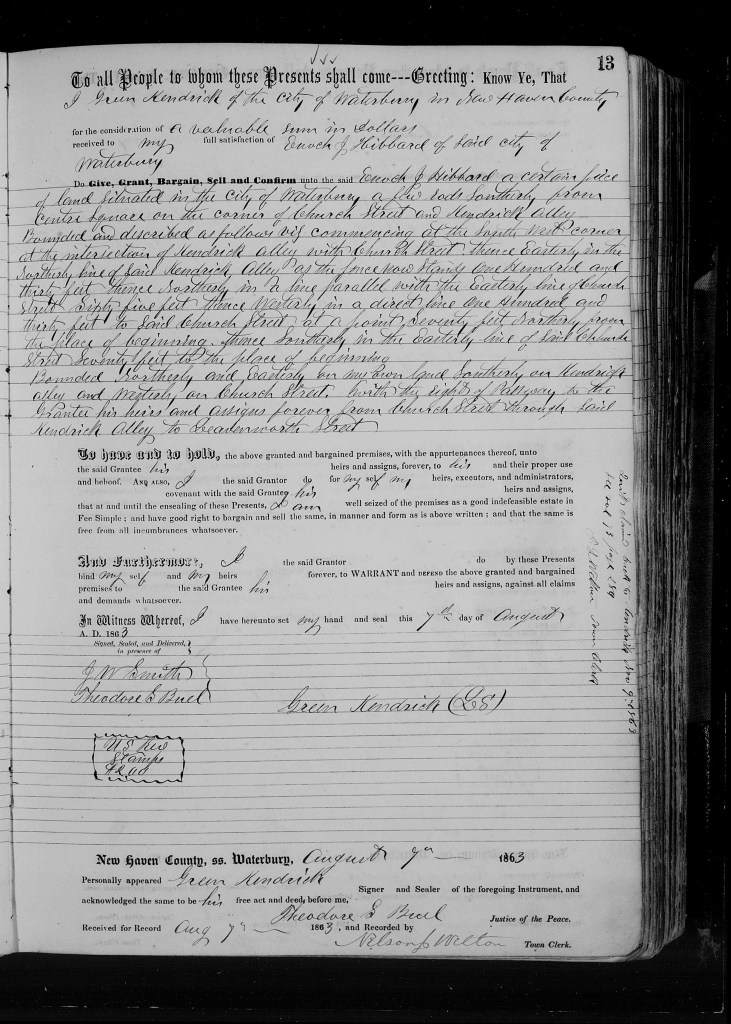
This deed appears on page 13 of Volume 75 of the Waterbury, Connecticut land records (accessible at https://www.familysearch.org/search/catalog/360248?availability=Family%20History%20Library). At first glance, it looks like a deed. It’s actually a mortgage: Green Kendrick is being lent money by Enoch Hibbard.

How do I know? First, the amount of the sale isn’t specified. That can sometimes illustrate a family relationship, but in this case, they specified that money was exchanged – so there’s another reason.

Second, there’s another deed.

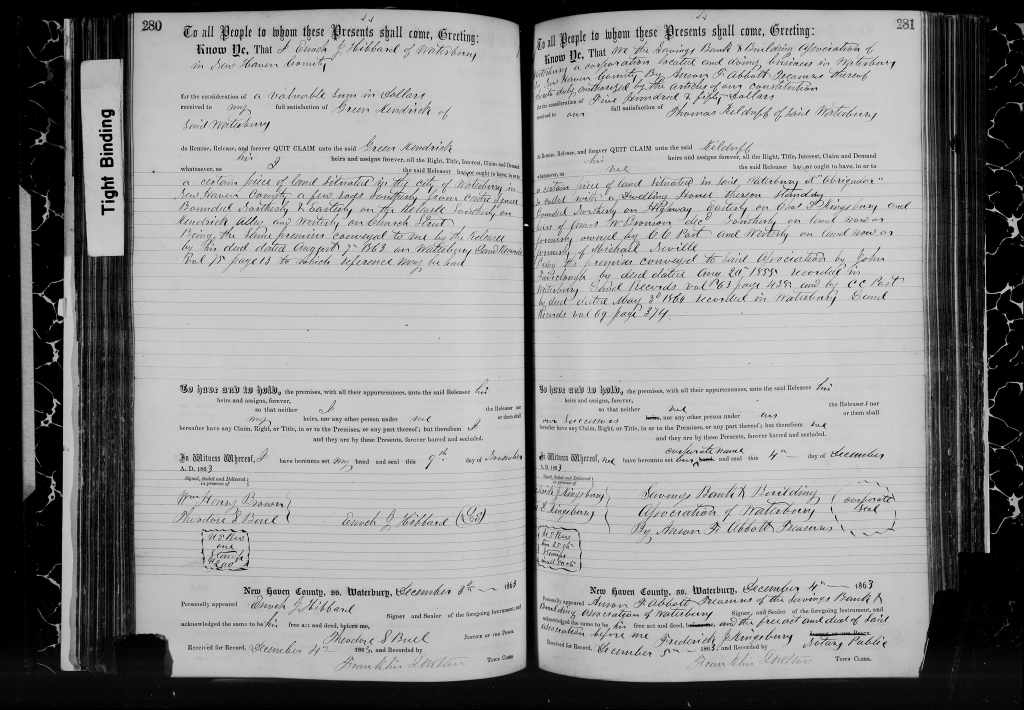
From volume 73,

It’s dated December of the same year. This deed contains information marking it as a mortgage release: it describes Kendrick as a “releasee.” Third, there are multiple transactions between the same parties in quick succession. A property might be sold multiple times in a year, but you’d be unlikely to sell it back to the same person within a few months – or less.

Pay close attention to the details of any land sales your ancestor conducted. It can be quite challenging to differentiate between a true sale and a mortgage or a mortgage release.

How do I develop historical context for a Connecticut ancestor?

Of the genealogical uses of AI currently being discussed is AI’s purported ability to establish historic context. In reality, LLMs aren’t that great at specifics – they’re looking at predictive patterns, so they’re likely to pull in anything strongly associated with the question you asked. In a recent test, that lead to an LLM extensively explaining how tobacco was grown in Lyme, Connecticut. Tobacco is one of the best known crops in late 19th and early 20th century Connecticut – which is why the LLM pulled in the information – but it was grown in the Windsor area, much further north. To get specific information about an ancestor’s experience in a certain time and place, it’s best to do the research by hand.

Many of us will start online, just with a search engine instead of an LLM. Once we do that, we get into the complicated discussion of media literacy. How do we know the website we’re looking at is reliable for historical research?

The National Association for Media Literacy Education offers a list of questions for you to consider when evaluating a site.

Let’s apply them to a research question. My ancestor, Joshua Warren Stark, was recorded on the 1900 census for Lyme, Connecticut as a farmer. I want to know what crops he might have grown. I’ll ask this question to Google: What crops were grown in Lyme, Connecticut in 1900?

Here are the first five results:

Let’s look at the first one, from Connecticut History.org.

We can try to answer the key questions:

Authorship:

  • Who made this? Connecticut History.org is funded by Connecticut Humanities, an affiliate of the National Endowment of the Humanities.
  • Who was and was not involved in the creation of this? “The project was developed in partnership with the University of Connecticut Digital Media Center, University of Connecticut Libraries, and the Roy Rosenzweig Center for History and New Media at George Mason University.”
  • When was this made? It has been online since 2012 and is still being added to.

Purpose:

  • Why was this made? To teach about Connecticut history.
  • What does it want me to do? Not really clear.
  • Who is the target audience? People interested in Connecticut history.

Economics:

  • Who paid for this? Connecticut Humanities
  • Who makes money from this? The writers

Just by looking at the big picture questions, we have a good sense the source might be reliable. It’s produced by organizations focused on education; it’s not bringing them income (not “clickbait”); and the content is relatively recent.

The site might be reliable, but is the article? More to come….

What was the Land Army – and how did it function in Connecticut?

The Woman’s Land Army of America was created in an effort to address a farm worker shortage during the First World War (“The Woman’s Land Army of America in World War I,” Digital History 511: Theory & Practice). Formally chartered in December 1917 (Weiss, Fruits of Victory, 67-68), the Land Army received a Connecticut chapter soon after (Fruits of Victory, 139-140). Eventually thirteen units of female volunteer “farmerettes” were created:Greenwich, Litchfield, Middletown, New Canaan, New Milford, Stonington, Washington, Wilton, Old Mystic, Pomfret, and three units on Long Island staffed by Connecticut College (Fruits of Victory, 140).

New Milford’s unit was somewhat controversial, as it focused on the tobacco harvest (“The New Milford Unit: The Woman’s Land Army of America in World War I,” Digital History 511: Theory & Practice)

Bibliography:

“The Woman’s Land Army of America in World War I,” Digital History 511: Theory & Practice (https://library.ccsu.edu/dighistFall16/exhibits/show/the-woman-s-land-army-of-ameri: accessed 1 July 2024)

“The New Milford Unit: The Woman’s Land Army of America in World War I,” Digital History 511: Theory & Practice (https://library.ccsu.edu/dighistFall16/exhibits/show/the-woman-s-land-army-of-ameri/the-new-milford-unit: accessed 1 July 2024)

Weiss, Elaine F. Fruits of Victory: The Woman’s Land Army of America in the Great War. Washington, DC: Potomac Books, 2008.

Looking for books on Connecticut history?

American Revolution:

Anderson, Virginia DeJohn. The Martyr and The Traitor: Nathan Hale, Moses Dunbar, and the American Revolution. New York: Oxford University Press, 2017.

Rees, John U. ‘They Were Good Soldiers’: African-Americans Serving in the Continental Army, 1775-1783. Warwick, England: Helion & Company, 2019.

Biography

Mahan, Russell. Thomas Leffingwell: The Connecticut Pioneer Who Rescued Chief Uncas and the Mohegans. Santa Clara, UT: Historical Enterprises, 2018.

Tomlinson, Richard G. Gershom Bulkeley, Zealot for Truth: The Conscience of Colonial Connecticut. N.P..: Richard G. Tomlinson, 2018.

Civil War

Banks,John. Hidden History of Connecticut Union Soldiers. Charleston,SC: The History Press, 2015.

Gordon, Lesley J. A Broken Regiment: The 16th Connecticut’s Civil War. Baton Rouge: Louisiana State University Press, 2014.

Staley,Patricia F. Norwich and the Civil War. Charleston, SC: The History Press, 2015.

Ethnic History

Hofffman, Betty N, editor. A History of Jewish Connecticut: Mensches, Migrants and Mitzvahs. Charleston, SC: The History Press, 2010.

Genealogy

MacLachlan, Linda. Finding Early Connecticut Vital Records: The Barbour Index and Beyond. Springfield, VA: Clearfield Co, 2019. This study of early vital records does an excellent job explaining the function and structure of the Barbour Index, as well as what resources are available at the Connecticut State Library. Do be aware outside resources are not well explained.

Maps

Virga, Vincent and Diana Ross McCain. Connecticut: Mapping the Nutmeg State Through History. Guilford,CT: Globe Pequot, 2018.

Natural Disasters

Hubbard, Robert. A History of Connecticut’s Deadliest Tornadoes: Catastrophe in the Constitution State. Charleston, SC: History Press, 2015.

New Haven Colony

Blue, Jon C. The Case of the Piglet’s Paternity: Trials from the New Haven Colony, 1639-1663. Middletown, CT: Wesleyan University Press, 2015.

Occupations

Dunlap, Brianna E. Connecticut Valley Tobacco. Charleston, SC: The History Press, 2016.

Ritter, Kathy A. Apprentices of Connecticut, 1637-1900. Salt Lake, UT: Ancestry Publishing, 1986. A finding aid to Connecticut apprenticeship records.

Slavery

Smith,Venture and Elizabeth J. Normen. Venture Smith’s Colonial Connecticut. West Hartford, CT: Connecticut Explored, 2019. An annotated version of Venture Smith’s narrative designed for children.

Stark, Bruce P. The Myth and Reality of Slavery in Eastern Connecticut. Cheshire, CT: The Connecticut Press, 2023.

Town Histories

Elliott, Melinda K. Connecticut Schoolhouses Through Time. N.P.: America Through Time, 2017. Largely a pictorial study, this text provides brief histories of Connecticut’s surviving historic schoolhouses.

Lehman, Eric D. Connecticut Town Greens: History of the State’s Common Centers. Guilford, CT: Globe Pequot, 2015. Part travel book, part history, this book can provide useful details on a town green.

Transit

DeLuca, Richard. Paved Roads & Public Money: Connecticut Transportation in the Age of Internal Combustion. Middletown, CT: Wesleyan University Press, 2020.

Griswold,Wick and Stephen Jones. Connecticut’s River Ferries. Charleston: The History Press, 2018. This text is mixed between contemporary accounts and historical narrative.

Hesselberg, Erik. Night Boat to New York: Steamboats on the Connecticut. Guilford, CT: Globe Pequot, 2022.

Miller, Max R. Along the Valley Line: The Story of the Connecticut Valley Railroad. Middletown, CT: Wesleyan University Press, 2017.

What was Saybrook Colony?

                 The settlement of Saybrook was part of a trading dispute between the English and the Dutch.[1] Seeking to control trade on the Connecticut River, the Dutch had built a trading point at what is now Saybrook Point by 1632.[2] In 1631, the British Earl of Warwick had issued “the Warwick Patent,” giving control of a large section of southern New England to those named in the patent.[3]  In 1635, John Winthrop, fearing that the Dutch would establish permanent control of the river, built a fort on the Point.[4]

                 The following year, the community found itself in the midst of the Pequot War.[5]  In that year, the Pequot community attacked both Cornfield Point and Guardhouse Point, with the intention of driving out the Saybrook Settlers.[6]

                 In 1644, George Fenwick, acting as Governor, sold Saybrook Colony to Connecticut Colony.[7]

Contemporary Towns Included in Saybrook Plantation[8]:

  1. Chester
  2. Deep River (called Saybrook until 1947)[9]
  3. Essex
  4. Lyme
  5. Old Lyme
  6. Westbrook
  7. Old Saybrook

Reference Texts:

Plimpton, Elizabeth Bull. The Vital Records of Saybrook Colony, 1635-1860.


[1] “1635-Saybrook,” The Society of Colonial Wars in the State of Connecticut (https://www.colonialwarsct.org/1635.htm: accessed 5 June 2024).

[2] “1635-Saybrook.”

[3] “History of Old Saybrook,” Old Saybrook Historical Society (https://saybrookhistory.org/history-of-old-saybrook/: accessed 5 June 2024).

[4] “History of Old Saybrook.”

[5] “Lion Gardiner Helps to Fortify Early Old Saybrook,” Connecticut History.org, 24 November 2020(https://connecticuthistory.org/lion-gardiner-helps-to-fortify-early-old-saybrook/: accessed 5 June 2024).

[6] “Lion Gardiner Helps to Fortify Early Old Saybrook.”

[7] “History of Old Saybrook.”

[8] “1635-Saybrook.”

[9] “List of Connecticut Towns & Counties Including Year Established,” Connecticut State Library (https://ctstatelibrary.org/cttowns/counties: accessed 5 June 2024).

Where do I start researching New Haven Colony?

Looking for the records of ancestors residing in New Haven Colony?

Here’s where to start:

Records: