
Of the genealogical uses of AI currently being discussed is AI’s purported ability to establish historic context. In reality, LLMs aren’t that great at specifics – they’re looking at predictive patterns, so they’re likely to pull in anything strongly associated with the question you asked. In a recent test, that lead to an LLM extensively explaining how tobacco was grown in Lyme, Connecticut. Tobacco is one of the best known crops in late 19th and early 20th century Connecticut – which is why the LLM pulled in the information – but it was grown in the Windsor area, much further north. To get specific information about an ancestor’s experience in a certain time and place, it’s best to do the research by hand.
Many of us will start online, just with a search engine instead of an LLM. Once we do that, we get into the complicated discussion of media literacy. How do we know the website we’re looking at is reliable for historical research?
The National Association for Media Literacy Education offers a list of questions for you to consider when evaluating a site.
Let’s apply them to a research question. My ancestor, Joshua Warren Stark, was recorded on the 1900 census for Lyme, Connecticut as a farmer. I want to know what crops he might have grown. I’ll ask this question to Google: What crops were grown in Lyme, Connecticut in 1900?
Here are the first five results:
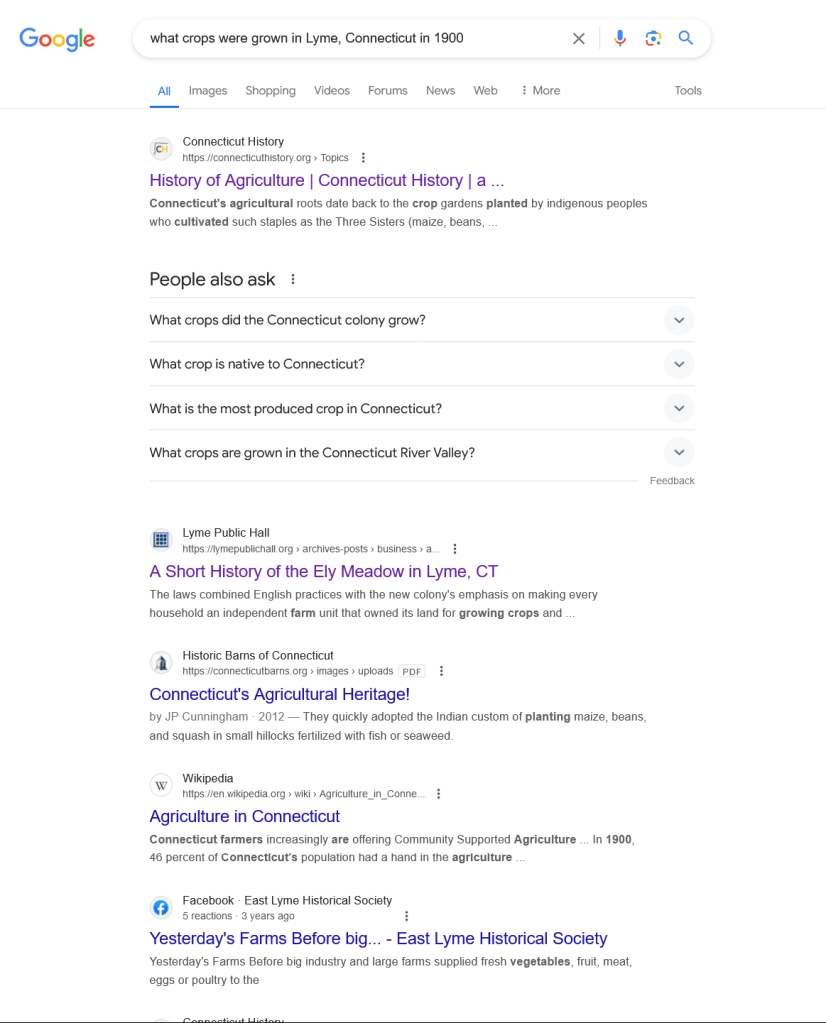
Let’s look at the first one, from Connecticut History.org.
We can try to answer the key questions:
Authorship:
- Who made this? Connecticut History.org is funded by Connecticut Humanities, an affiliate of the National Endowment of the Humanities.
- Who was and was not involved in the creation of this? “The project was developed in partnership with the University of Connecticut Digital Media Center, University of Connecticut Libraries, and the Roy Rosenzweig Center for History and New Media at George Mason University.”
- When was this made? It has been online since 2012 and is still being added to.
Purpose:
- Why was this made? To teach about Connecticut history.
- What does it want me to do? Not really clear.
- Who is the target audience? People interested in Connecticut history.
Economics:
- Who paid for this? Connecticut Humanities
- Who makes money from this? The writers
Just by looking at the big picture questions, we have a good sense the source might be reliable. It’s produced by organizations focused on education; it’s not bringing them income (not “clickbait”); and the content is relatively recent.
The site might be reliable, but is the article? More to come….
 Connecticut Roots by Charter Oak Genealogy