Connecticut and the Firelands

The Origins of the Firelands:

According to the Connecticut State Library, the Firelands were created as a result of the state of Connecticut’s attempts to recompense property owners for their losses after British attacks on Danbury, Fairfield, Norwalk, New London, and New Haven. In 1792, 500,000 acres of the Western Reserve was provided to survivors in proportion to their losses. William W. William’s History of the Firelands provides a list of those recompensed. That 500,000 acre area now contains – per Historic Lyme Village – “Erie and Huron Counties and Danbury Township in Ottawa County and Ruggles Township in Ashland County.”

In 1800, the “Quieting Act” transferred control of the Western Reserve from Connecticut to the Northwest Territory. An 1803 act created a company to distribute the promised property. The History of the Firelands indicates that the land was partitioned in 1808.

Why does this impact my family?

Connecticut ancestors are typically impacted by the Firelands in two ways. First, they may have received shares in the Firelands due to property damage. As such, they are likely named in petitions, on the list of petitioners, and possibly mentioned in the Ohio based company. Most remained in Connecticut, so outside of these records, they may not have records in Ohio. Second, some Connecticut ancestors took advantage of the survey to move. Their records are typically found in Ohio.

Research organizations in the Firelands:

Firelands Genealogical Society: https://www.hcc-ogs.org/

Firelands Historical Society: https://www.firelandsmuseum.com/

Huron Historical Society: https://www.thehuronhistoricalsociety.org/historical-markers/the-firelands-of-ohio/

Western Reserve Historical Society: https://www.wrhs.org/about/
What are the overseers of the poor, and how can they impact the research of my Connecticut ancestor?

Connecticut had a public welfare system in place by 1702. The law read:

Be in enacted and declared by the Governour, Council, and Representatives, in General Court Assembled, and by the Authority of the same, That when and so often as it shall happen, any person to be naturally wanting of understanding, so as to be uncapable to provide for him, or her self; or by the Providence of God, shall fall into Destraction, and become Non Compos Mentis, and no Relations appear, that will undertake the care of providing for them; or that stand in so near a degree, as that by Law they may be compelled thereto; in every such case the Select men, or overseers of the poor of the Town, or Peculiar, where such person was born, or is by Law an Inhabitant, be and hereby are Impowred and required, to take effectual care, and make necessary Provision, for the relief, support, and safety […]

Acts and Laws of His Majesties Colony of Connecticut in New England, Printed in 1702 and now first reissued, 54; digital images, Hathitrust (https://hdl.handle.net/2027/mdp.35112105064069?urlappend=%3Bseq=74%3Bownerid=13510798901909985-82: acccessed 14 August 2023).

The law continues to allow the town to use the individual’s assets for their care and to employ them as they are deemed capable.

Setting aside the moral and ethical questions of the system, the records of the overseers of the poor can still be valuable for research. They record individuals who may have been chronically ill or simply poor. These records are held at the town level and at the state archives (depending on the town) and typically include the receipts for an individual’s care and any related legal documents, such as an indenture.

Did Connecticut require vital records for those held in slavery?

As early as 1702, the requirement to register births and deaths included “masters” in addition to parents. Recording was inconsistent: although there was a penalty for failure to register, it’s unclear if it was ever enforced. In short, while there are only a small number of records for those held in slavery, it’s important to check for any individual being researched.

How do you do that?

In the vast majority of cases, these records are part of the vital records for the community in which the individual resided. For Middletown, I went to www.familysearch.org (already having logged in, as I know I need an account). I clicked on “Search” and “Catalog”. In the place box, I entered “United States, Connecticut, Middlesex, Middletown”and clicked the “Search button.” In the results list, I clicked on “vital records.” The last item is my point of interest. I clicked on it and was able to open digital images of the books covering births, deaths, and marriages for the period I sought.

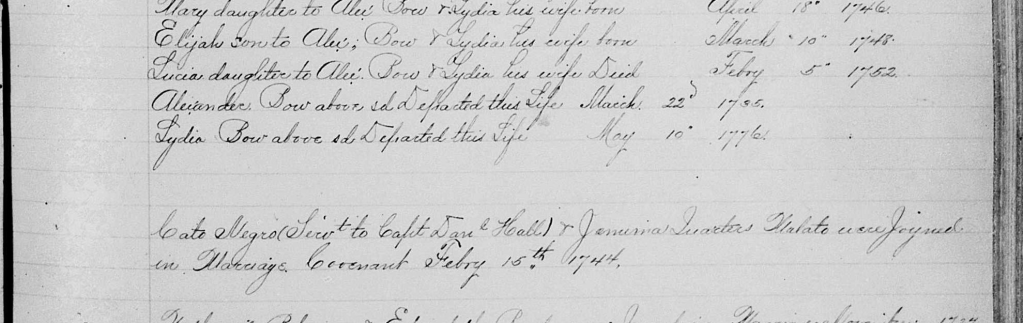
On page 53 of volume 2, I found this:

Cato Negro (Servt to Capt Daniel Hall) + Jemima Quarters Mulato were Joyned in Marriage Covenant February 15th 1744

Due to the argument that the enslaved were property, some town clerks included their birth, death, and marriage records in land record books instead of the vital record books. These books are also available on FamilySearch (click on land records instead of vital records), but they typically need to be accessed from FamilySearch affiliate libraries.

Questions? Contact us.

Why did the town indenture my Connecticut ancestor?

19th century Connecticut newspapers include ads to reclaim those who had escaped indenture. Indenture, on the basic level, meant that someone “bound” themselves to an employer to work for a set period of time in exchange for some form of reward. Why do some of those ads mention the town as the ones doing the binding?

The reasoning is actually defined in Connecticut Statute:

If any person, who has had relief from any town, shall suffer his children to mis-spend their time, and shall neglect to employ them in some honest calling, or if any person does not provide competently for his children, whereby they are exposed to want, or if any poor children, in any town, live idly, or are exposed to want, and there are not to take care of them, the selectmen of such town, with the assent of a justice of the peace, shall in indenture such children […]

The General Statutes of the State of Connecticut, Revision of 1875 (Hartford: The Case, Lockwood & Brainard Co., Printers, 1875), 193.

In short, if the town thought they needed to be involved to protect the child, they could complete the contract themselves.

Are there multiple versions of the Barbour Collection?

The Barbour Collection is an index and abstract of pre-1850 Connecticut vital records created in the early 1900s. For a history of the collection, see the “LibGuide” on the Connecticut State Library website. It’s a commonly used resource for Connecticut research, and, as it’s considered to be generally reliable, is accepted as “proof” by many lineage societies.

If you’ve looked at the online versions of the Barbour Collection, you may have noticed that they don’t all look the same. The term “Barbour Collection” is actually applied to three collections:

  1. The slip index: The first step in the collation process, the slip index is the most complete version of the collection, as it contains towns not included in the bound versions. (See the “LibGuide” for details.) The source of the record transcription is indicated directly on the card. The slip index has been digitized by FamilySearch as “Connecticut, Vital Records, Prior to 1850″.
  2. Bound volumes: Bound volumes were prepared as the final step in the transcription and collation process. They are often tertiary transcriptions – the original transcription having been transcribed onto the slip index, which was alphabetized before being transcribed again – so transcription errors are likely. The source information for the volumes is at the front. The bound volumes are digitized but not searchable on FamilySearch. They are digitized and searchable on American Ancestors.
  3. Lorraine Cook White publication: The bound volumes were transcribed again in the late 1990s and early 2000s and published under the editorship of Lorraine Cook White. These volumes do not include the source information and have been partially digitized by Ancestry.

Which Connecticut genealogical societies can help me learn more about my ancestors?

While not all of Connecticut’s genealogical societies include a focus on Connecticut ancestry, those that do can offer unique resources for learning more about your Connecticut roots.

Here’s a partial list of societies and a few of their offerings:

The Polish Genealogical Society of Connecticut and the Northeast offers resources on research in Connecticut and Poland and offers the chance for members to connect.

The Connecticut Ancestry Society and the Connecticut Society of Genealogists both offer scholarly journals on Connecticut genealogy.

The French-Canadian Genealogical Society of Connecticut offers a journal, a card file of Connecticut vital records for those with French surnames and more…

Looking for programs specifically on Connecticut ancestry? Be sure to let your society of interest know.

Stuck researching a Connecticut ancestor? Have you checked these sources?

Sometimes we get stuck in research simply because we don’t know where to look next. While this list is far from exhaustive – and will apply better to the colonial period – here are sources you can check to learn more about your Connecticut ancestors.

  • The U.S. Census: While Connecticut did have a colonial census, the listed names have largely not survived. A deep dive into the U.S. Census may still provide the information you need.
  • Vital records: Connecticut has had birth, death, and marriage records since the 1640s. Not every ancestor will have a record, but it’s always worth checking. Pre-1900 records are largely available on FamilySearch.
  • Church records: The Congregational Church was the establishment or state church until 1818. Not all records have been indexed, but those that have are can be found in the “Connecticut, U.S., Church Record Abstracts, 1630-1920” collection on Ancestry. Index cards created in the process of making the same publication are available on FamilySearch.
  • Land records: Land ownership became less common in the late 19th and 20th centuries, but it can be an effective way to follow the movements of earlier ancestors. Land records are stored in the office of the town clerk in which the property was located at the time the transaction occurred. Many clerks have digitized their most recent records and made them accessible through their website; many older records are available on FamilySearch.
  • Probate files: If your ancestor died with assets, they may have a probate file naming their heirs or providing family information. Many Connecticut probate records have been digitized and made available by both FamilySearch and Ancestry.

Keep in mind, these are a starting point. There are many more sources which may document your ancestors!

What does “removal” mean in a burial record?

From sexton’s books to burial transit permits, Connecticut has remarkably good civil burial records. The term removal appears in many of those records. What does it actually mean?

The term “removal” is used to indicate that the remains were moved from one town to another. If it appears in the town’s sexton’s books, it’s usually a good indication that the person died elsewhere and their remains were brought into town to be buried. The burial transit permit should confirm the locale of death.

The Hale Collection: A Resource for Cemetery Inscriptions

An outgrowth of a project to document veteran’s graves, the Hale Collection was largely compiled between 1932 and 1935. To create the collection, staffers visited the town, attempted to locate all relevant cemeteries, and transcribe the headstones. Those transcriptions were then organized into volumes by town and then by cemetery. The volumes are available on both FamilySearch and Ancestry.

Why do researchers use the Hale Collection? Many headstones in the Connecticut River Valley are made of brownstone, a soft sandstone. In the weather extremes of recent years, the faces of many tombstones have been falling away, leaving them totally unreadable.

You can see where this headstone has lost some inscription.

The Hale Collection captures the inscriptions decades earlier, when they were typically far more intact. Staffers also covered all known burials in the cemetery, making it easier to locate listings than on many of the contemporary websites.

However, there are a few issues you should note. First, the Hale is a derivative source, and like all derivative sources, may contain copying errors. Second, because it is a transcription, it is impossible to date the age of the stone being transcribed and to identify any replacement stones. Finally, there is no publicly available set of instructions for recording the cemetery, so it’s impossible to tell if family groupings or burial order was maintained.

The Hale Collection only covered Connecticut, but it has left Connecticut resources with an incredibly valuable resource for learning more about our ancestors.

How do I find my ancestor’s Connecticut divorce record?

Connecticut’s statute allowing for divorce dates from 1667, created under the argument that marriage – and thus divorce – was a civil contract. The superior court system was given jurisdiction over divorce cases as early as 1784. In 1849, it officially became exclusive. Yet, many still petitioned the Connecticut General Assembly.

The Connecticut State Library has an excellent resource guide that can be used to direct you to the applicable indexes and records.